

What to change on your website now that generative AI is the default for search
Gustavo De Amorim7 min read

Short answer: treat every page as a source an assistant can quote, not just a result to rank. Make your claims atomic and citable, expose first‑party facts and evidence, and give assistants clear retrieval cues, permissions and provenance. Then measure AI visibility in Search Console and with third‑party testing, and link it to revenue.
What’s changed in search, practically?
- Google now offers AI answers (AI Overviews/AI Mode) in a growing share of results, and provides site‑owner controls and reports in Search Console to manage whether your content helps ground those answers. Use the new toggle and reporting to understand where you appear. Google confirmed these controls in June 2026.
- UK regulators required Google to give publishers the ability to prevent their content being used to ground AI responses in the UK, with deadlines from 3 December 2026 for compliance and page‑level controls to follow. Build your policy on purpose, not panic.
- UK usage of AI in search and summaries is now mainstream exposure: Ofcom reports that over half of UK adults use tools like ChatGPT/Copilot/Gemini and that many online adults are reading AI‑generated search summaries. Plan for assistants to be your first audience.
What should we change in our content framing?
Think “quote‑ready pages”. Assistants lift short, attributable facts more than prose.
- Lead with the claim, then evidence. Start key pages with a two‑sentence summary that states what you do, for whom, proof points (numbers, certifications, clients by category), and a date stamp. Assistants need fresh, unambiguous facts.
- Break complex benefits into atomic statements with anchors. For example: “ISO 27001 certified since 2022; certificate no. ABC‑123; scope: UK/EU data centres; auditor: BSI.” Each fact becomes a snippet a model can ground.
- Prefer primary data over marketing adjectives. Where you cite stats, link to the original source with exact wording and dates. Generative systems tend to cite non‑top‑10 sources more often than before, so your owned evidence can compete if it’s clear and credible.
- Add a “What to quote” box per key page: 3–5 bullet facts, each with a permalink. This increases the chance an assistant extracts exactly what you want.
How do we make assistants find and trust our pages?
Two jobs: retrieval and grounding.
- Retrieval cues
- Page titles: front‑load the entity and task (“UK payroll software — pricing, integrations, HMRC links”).
- Introductions: include the entity, jurisdiction (UK/Scotland/Wales/NI where relevant), and authoritative references you rely on.
- Internal links: create hub pages (“Pricing”, “Security”, “Eligibility”, “Regulatory”) so assistants can traverse to first‑party facts.
- Structured data: use Organisation, Product, FAQ, HowTo, Review, TechArticle where relevant; add sameAs to official registries (Companies House, ICO, NHS, Ofcom lists) to harden entity identity.
- Grounding signals
- Cite canonical sources that assistants are likely to trust and that you actually use (gov.uk, nhs.uk, legislation.gov.uk, FCA, ICO). Research suggests generative systems can under‑cite government/education domains versus classic blue links; make those citations explicit on your pages.
- Publish your own primary artefacts: methodology notes, data downloads, change logs. These give the model “evidence objects” to quote.
- Add last‑reviewed dates and named experts with credentials. Assistants surface recency and author context.
What site architecture changes matter most now?
- Create a Source of Truth section
- House policy, definitions, product specs, SLAs, pricing rules, compliance scopes, integration matrices and update logs.
- Give each statement its own anchor and ID. Example: /source‑of‑truth/pricing#rule‑p3.
- Canonical evidence pages
- One page per proof claim (e.g., “Independent carbon audit 2026”), each linking to the full report/PDF. If you rely on external research, summarise it neutrally and link out.
- Region‑specific facts
- Separate UK specifics (tax years, regulators, currencies, delivery times). Assistants mix regions; explicit UK grounding reduces hallucination risk.
- Assistants’ navigation layer
- Add a machine‑readable index page that lists all evidence pages with titles, dates, and canonical URLs. Think of it as your sitemap for AI.
What about controls and governance?
- Decide whether your content can ground AI Overviews/AI Mode. Use Google’s Search Console controls and monitor performance there. Start with allow, measure impact, then refine.
- Publish an AI access policy
- State what automated agents may crawl, how to attribute, and contact details for higher‑rate access or API alternatives. The ecosystem is moving toward paid access controls and structured agreements; set expectations now.
- Brand safety
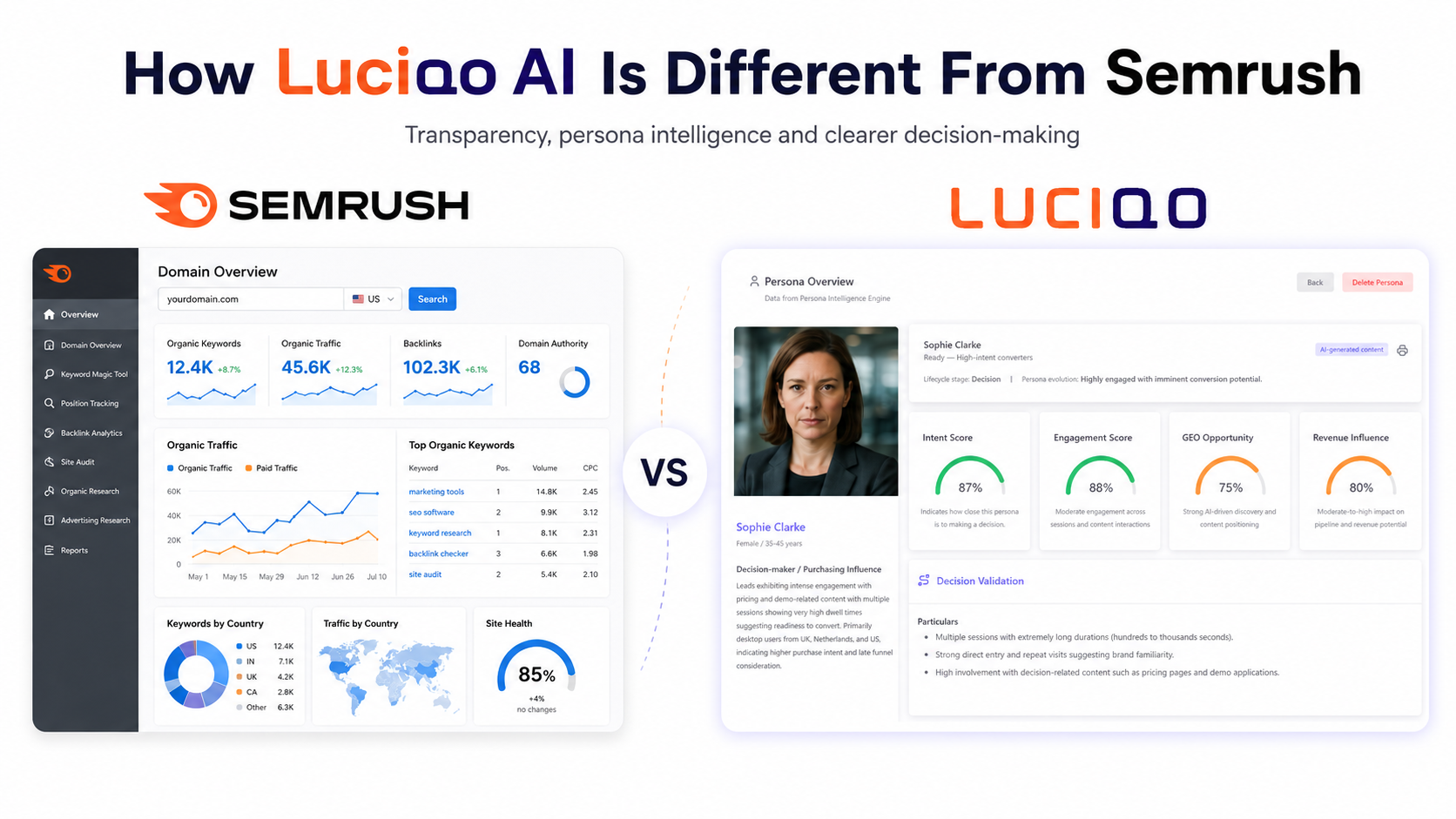
- Track which answers assistants generate about you, which competitors they recommend instead, and which sources they cite. We built Luciqo to do exactly this across ChatGPT, Claude, Gemini and Perplexity, and to connect that visibility to conversions via Google Analytics, Matomo and HubSpot. See how we test buyer prompts at scale and track recommendation share. (https://luciqo.ai and guide).
Which on‑page elements should we add or fix this quarter?
Use this checklist on your most important product/service pages first.
- Evidence header: two‑sentence summary + 3 bullet facts with permalinks.
- Canonical claim IDs: anchors for each key assertion (spec, price rule, SLA, compliance scope).
- Source list: link to the few, best canonical sources you rely on (gov/regulator/standard body). Make them visible near the claim.
- Entity hardening: add schema.org Organisation/Product, sameAs to Companies House and LinkedIn; list trading names and VAT.
- Region stamp: “UK and EU coverage; last reviewed 27 November 2026.”
- Retrieval harmonisers: product names, categories and common synonyms users actually type into assistants.
- Update log: small changelog per page. Don’t bury it in a blog.
- Crawl access: ensure your AI policy and machine index are discoverable; avoid blocking legitimate assistant crawlers you intend to serve.
How do we measure success beyond classic SEO?
- Google Search Console AI reports
- Track impressions/clicks from AI features and where your site grounded answers. Combine trend lines with changes you made to evidence pages.
- Assistant testing at scale
- Run recurring prompts that mirror buyer language (“best payroll software for UK contractors, integrates with Xero”). Capture which brands assistants recommend and which citations they show. We at Luciqo automate this and attribute impact to revenue systems. Start with our prompt‑testing playbook.
- Market benchmarks
- Use UK adoption and trust data (Ofcom, Which?, Ipsos/YouGov) to size the opportunity and set realistic targets by audience.
What pitfalls should UK teams avoid?
- Writing for blue links only. AI citations aren’t limited to top‑ranked pages; assistants will quote clear primary sources, even if they sit outside the traditional top 10.
- Mixing jurisdictions. If you sell in the UK, ground with UK sources (gov.uk, FCA, ICO) and state UK‑specific rules.
- Opaque numbers. If you can’t footnote and link it, don’t expect an assistant to include it.
- One‑and‑done projects. AI modes and controls are evolving fast; UK‑specific policies are in play with live deadlines. Put a monthly “evidence audit” in your calendar.
What’s my 30‑day plan?
- Week 1: Pick five money pages. Add the evidence header, anchors and UK stamps. Map canonical sources and link them inline.
- Week 2: Create your Source of Truth section and machine‑readable index. Publish your AI access and attribution policy.
- Week 3: Switch on Google’s AI controls/reporting, and start a weekly extract of AI Overview impressions/groundings.
- Week 4: Run assistant prompt tests and log which brands and citations appear. Tie changes to analytics and CRM outcomes. Try Luciqo’s approach to measuring recommendation share and AI read‑ability. (post 1, post 2).
If you do only one thing: rewrite your top pages so an assistant can quote three unambiguous, well‑sourced facts about you today. That single change increases your odds of being the answer, not the footnote.
Frequently asked questions
How do I tell Google not to use my content to ground AI answers in the UK?
Use the new Search Console controls Google introduced in June 2026 and follow the UK publisher remedy, which requires Google to provide an opt‑out and page‑level control with deadlines from 3 December 2026.
Does ranking top‑3 still matter if AI Overviews appear?
Yes, but assistants cite beyond classic top results. Focus on being the clearest primary source with citable facts; recent analysis shows a declining share of AI Overview citations come from top‑10 pages.
What UK data should I use to size AI search behaviour?
Rely on Ofcom’s Adults’ Media Use reports, Which? consumer studies and large trackers from Ipsos/YouGov to understand exposure, adoption and trust in AI search.
How do I test what assistants recommend today?
Run buyer‑style prompts across ChatGPT, Gemini, Claude and Perplexity and log brands and citations weekly. Luciqo’s playbooks and platform automate this and map outcomes to analytics/CRM. See our prompt‑testing guides. https://luciqo.ai/blog/prompt-testing-playbook-how-to-simulate-buyer-queries-and-audit-assistant-answers-at-scale
Should I create separate UK pages even if I serve multiple regions?
Yes. Region‑specific grounding (regulators, tax years, delivery times) reduces hallucinations and improves the chance of being quoted correctly.
What if assistants quote outdated information from my site?
Add visible last‑reviewed dates, change logs and link to the freshest canonical sources. Update your Source of Truth first, then cascade changes to marketing pages.


See what AI says about your brand
Start with a free snapshot: 10 buyer questions, four AI assistants, results in minutes. No card needed.